


 David Bowie, the visionary British rock star who coupled hits
such as “Space Oddity” with trend-setting pop personas like “Ziggy
Stardust,” has died at age 69, apparently of liver cancer, just two days
after releasing what appears to be the parting gift of a new album.
A pioneering chameleon of performance imagery, Bowie straddled the
worlds of hedonistic rock, fashion, art and drama for five decades,
pushing the boundaries of music and his own sanity to produce some of
the most innovative songs of his generation.
“David Bowie died peacefully today surrounded by his family after a
courageous 18-month battle with cancer,” read a statement on Bowie’s
Facebook page dated Jan. 10. Bowie’s son, film director Duncan Jones,
confirmed the
death.
A spokesman for Bowie said he died on Sunday but declined to say
where he died or from what type of cancer. Bowie had kept a low profile
after having emergency heart surgery in 2004 and it was not publicly
known that he had cancer.
Belgian stage director Ivo van Hove, who directed the current
off-Broadway experimental play “Lazarus,” which Bowie co-created and for
which he provided much of the music, said the singer had been diagnosed
with liver cancer some 15 months ago.
“He told me more than a year and three months ago just after he had
heard himself … he said it was liver cancer,” van Hove told Dutch public
radio broadcaster NOS in an interview on Monday.
“I saw a man who didn’t want to die, he really didn’t want to die. …
He was in a battle for his life. Sometimes he looked at me and I saw a
man who was suffering through and through because he knew the clock was
ticking,” the director told Dutch TV in a separate interview.
One of Bowie’s last-known public appearances was in New York in mid-December to watch the show, which is due to close on Jan 19.
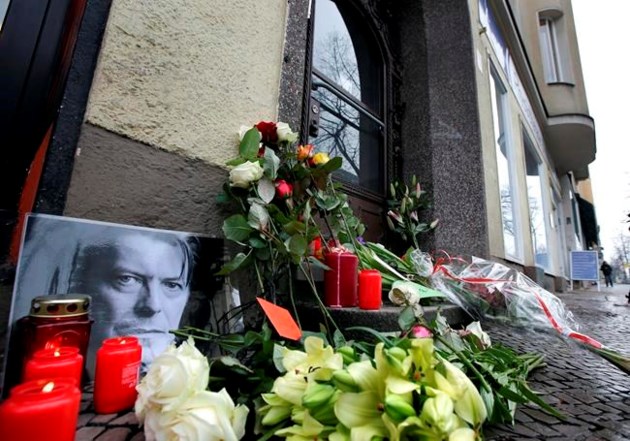
In London, mourners laid flowers, lit candles and sang his greatest
hits besides a mural to Bowie in the edgy Brixton district of south
London where he was born
Fans also gathered and laid flowers outside the apartment building in New York’s trendy Soho district where he had a home.
Bowie died two days after releasing “Blackstar”, which won some of
the best critical reviews of his career. A music video for the first
single, “Lazarus,” showed him lying in a hospital bed with bandages
across his eyes, and singing lyrics that after his death, took on added
poignancy.
“I’ve got scars that can’t be seen. I’ve got drama, can’t be stolen.
Everybody knows me now. Look up here, man, I’m in danger. I’ve got
nothing left to lose,” Bowie sang.
“He made ‘Blackstar’ for us, his parting gift. I knew for a year this
was the way it would be. I wasn’t, however, prepared for it,” Bowie’s
record producer, Tony Visconti, wrote on his Facebook page on Monday.
Sales and streaming of “Blackstar” and Bowie’s older albums soared on
Monday, rising to the top of Apple’s iTunes charts in the United States
and the UK. Streaming service Spotify said streams of Bowie’s music
were up 2,700 percent on Monday.
Tributes poured in from titans of popular music, including the Rolling Stones, Madonna, rapper Kanye West and Paul McCartney.
“I’m proud to think of the huge influence he has had on people all
around the world. … His star will shine in the sky forever,” McCartney
said.
“The Rolling Stones are shocked and deeply saddened to hear of the
death of our dear friend David Bowie,” the Stones said. “He was an
extraordinary artist, and a true original.”
Madonna said on Twitter: “Talented. Unique. Genius. Game Changer. The Man who Fell to Earth. Your Spirit Lives on Forever!”
The Vatican said: “Check ignition and may God’s love be with you” – borrowing a verse from Bowie’s first hit, “Space Oddity.”
Born David Jones in south London on Jan. 8, 1947, he took up the
saxophone at 13 before changing his name to David Bowie to avoid
confusion with the Monkees’ Davy Jones, according to Rolling Stone.
He shot to fame in Britain in 1969 with “Space Oddity,” whose words
he said were inspired by watching Stanley Kubrick’s film “2001: A Space
Odyssey” while stoned.
Bowie’s haunting lyrics summed up the loneliness of the Cold War
space race between the United States and the Soviet Union and coincided
with the Apollo spacecraft landing on the moon.
Bowie married the Somali-American supermodel Iman in 1992 with whom he had a daughter, Alexandria Zahra Jones, born in 2000.
‘ZIGGY STARDUST’
It was Bowie’s 1972 portrayal of a doomed bisexual rock envoy from
space, Ziggy Stardust, that propelled him to global stardom. Bowie and
Ziggy, wearing outrageous costumes, makeup and bright orange hair, took
the pop world by storm.
He defined the theatrical glam rock movement with the albums “Hunky
Dory”, “The Rise and Fall of Ziggy Stardust and the Spiders from Mars”,
and “Aladdin Sane”.
“Ziggy played guitar, jamming good with Weird and Gilly,” Bowie sang
with a red lightning bolt across his face and flamboyant jumpsuits.
“Making love with his ego, Ziggy sucked up into his mind, like a leper
messiah.”
By now an influential symbol of artistic reinvention venturing into
the theatre, film and fashion worlds, Bowie continued to innovate,
helping produce Lou Reed’s “Walk on the Wild Side” and Iggy Pop’s “Lust
for Life” album.
This was a period that saw Bowie sporting an array of fantastic
costumes, some said to based on the chilling Kubrick movie “A Clockwork
Orange”.
“The trousers may change, but the actual words and subjects I’ve
always chosen to write with are things to do with isolation,
abandonment, fear and anxiety, all of the high points of one’s life,”
Bowie said in a rare interview in 2002.
Ever ahead of public opinion, Bowie told the Melody Maker newspaper
in 1972 that he was gay, a step that helped pioneer sexual openness in
Britain, which had only decriminalised homosexuality in 1967. Bowie had
married in 1970.
Four years later, he informed Playboy that he was bisexual, but he
told Rolling Stone magazine in the 1980s that the declaration was “the
biggest mistake I ever made” and that he was “always a closet
heterosexual.”
‘LET’S DANCE’
Bowie went through another metamorphosis in the mid-1970s, adopting a
soul and funk sound and abandoning stack heels for designer suits and
flat shoes.
He scored his first U.S. No. 1 with “Fame” and established a new
persona, the “Thin White Duke”, for his “Station to Station” album.
But the excesses of a hedonistic life were taking their toll. In a
reference to his prodigious appetite for cocaine, he said: “u201cI blew
my nose one day in California. u201cAnd half my brains came out.
Something had to be done.”
Bowie moved from the United States to Switzerland and then to Cold
War-era Berlin to recuperate, working with Brian Eno from Roxy Music to
produce some of his least commercial and most ambitious music, including
“u201cLow” and u201c”Heroes” in 1977.
He scored a big hit with funk dance track “Fashion” in 1980.
In 1983, Bowie changed tack again, signing a multimillion-dollar
five-album deal with EMI. The first, u201c”Let’s Dance”, returned him to
chart success and almost paid off his advance.
He starred on Broadway in “The Elephant Man” at the start of the
decade and appeared in an array of films including “Merry Christmas,
“The Hunger”, “Absolute Beginners” and as Pontius Pilate in Martin
Scorsese’s “The Last Temptation of Christ”.
