



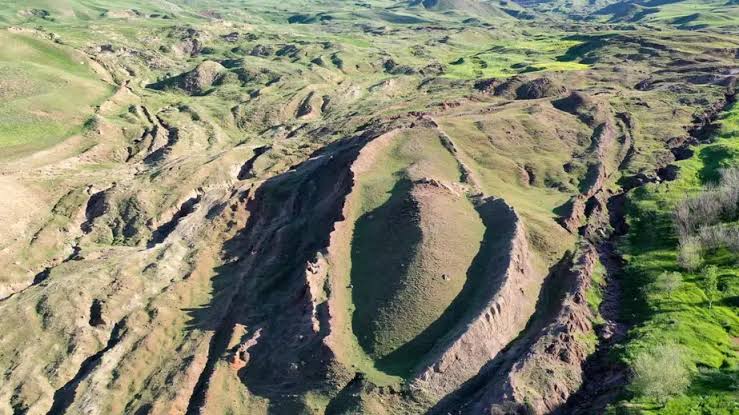
Researchers investigating a boat-shaped formation in Turkey say new underground scans have revealed features they believe could be man-made, fueling fresh speculation that the site may be linked to the biblical story of Noah’s Ark. The team claims radar surveys detected possible chambers, corridors, and layered structures beneath the Durupınar Formation near Mount Ararat. Core samples have also revealed organic material that researchers are testing for traces of decayed wood.
The Noah’s Ark site Turkey investigation has drawn intense interest for decades. The formation, first identified in aerial photographs in 1959, sits about 18 miles south of Mount Ararat, where the Book of Genesis says the Ark came to rest after a catastrophic flood. Its roughly 160-meter length has long attracted attention because it is close to some estimates of the Ark’s dimensions described in scripture. A deeper radar survey conducted in 2026 by Dr. Khosrow Bakhtar used an advanced system capable of probing significantly deeper than earlier equipment, detecting what the team interpreted as sediment-filled cavities and a possible tunnel system extending roughly 151 feet.
Andrew Jones, who has studied the site for nearly 30 years, called the findings a “compelling new line of evidence” and said he believes the formation could contain the Ark’s remains. “I firmly believe the Durupınar Formation represents the buried remains of Noah’s Ark,” he said, while acknowledging the evidence has not definitively identified the site as the biblical vessel . However, researchers have yet to confirm that the underground features are man-made, identify the organic material as wood, or scientifically date the site to the biblical flood. The readings are not photographs of exposed rooms or passageways, they show how radar waves reacted to different materials and boundaries beneath the ground, and those anomalies must be physically investigated before researchers can determine what produced them. Most geologists have long regarded the formation as a natural geological structure, and earlier research concluded it was not the remains of a boat.